How to Clean a Showerhead with Vinegar
If your shower has started spraying sideways, dribbling from a few holes, or feeling weaker than usual, hard water buildup may be the problem. The good news is that you can often clean a showerhead with vinegar, a plastic bag, and a little patience—no harsh fumes or complicated tools required.
This is a small bathroom chore that pays off right away. The U.S. EPA’s WaterSense home maintenance guidance recommends checking showerheads for scale buildup and using a cleaning product or white vinegar to remove it. ([epa.gov](https://www.epa.gov/watersense/home-maintenance?utm_source=openai))
Why Showerheads Get Clogged
Most showerhead clogs are not mystery grime. They are usually mineral deposits from hard water, especially calcium and magnesium. As water dries on and inside the spray holes, those minerals can leave chalky white crust, block nozzles, and make the spray pattern uneven.
Soap residue and normal bathroom film can add to the problem, especially around the face of the showerhead. If you live in a hard-water area, you may need to clean the showerhead more often than someone with naturally soft water.
What You’ll Need
- Distilled white vinegar
- A sturdy plastic food storage bag
- Rubber band, twist tie, or painter’s tape
- Old toothbrush or small cleaning brush
- Toothpick or wooden skewer
- Microfiber cloth
- Adjustable wrench, if removing the showerhead
- Small towel, to protect the fixture if using a wrench
Use plain distilled white vinegar, not a vinegar-and-baking-soda mixture. Vinegar is acidic, which helps dissolve mineral scale. Baking soda is alkaline, and when you mix the two, they fizz impressively but mostly neutralize each other. For showerhead holes, vinegar alone is usually the more useful cleaner.
Before You Start: Check the Finish
Vinegar is helpful for mineral buildup, but it is still an acid. Most chrome showerheads tolerate a short vinegar soak well, but some specialty finishes—such as oil-rubbed bronze, unlacquered brass, nickel, or matte black—may be more sensitive.
If you have a high-end or specialty finish, check the manufacturer’s care instructions first. When in doubt, do a shorter soak, dilute the vinegar with equal parts water, and avoid leaving vinegar on the finish overnight. Always rinse thoroughly after cleaning.
Method 1: Clean a Fixed Showerhead Without Removing It
This is the easiest method and works well for most fixed showerheads.
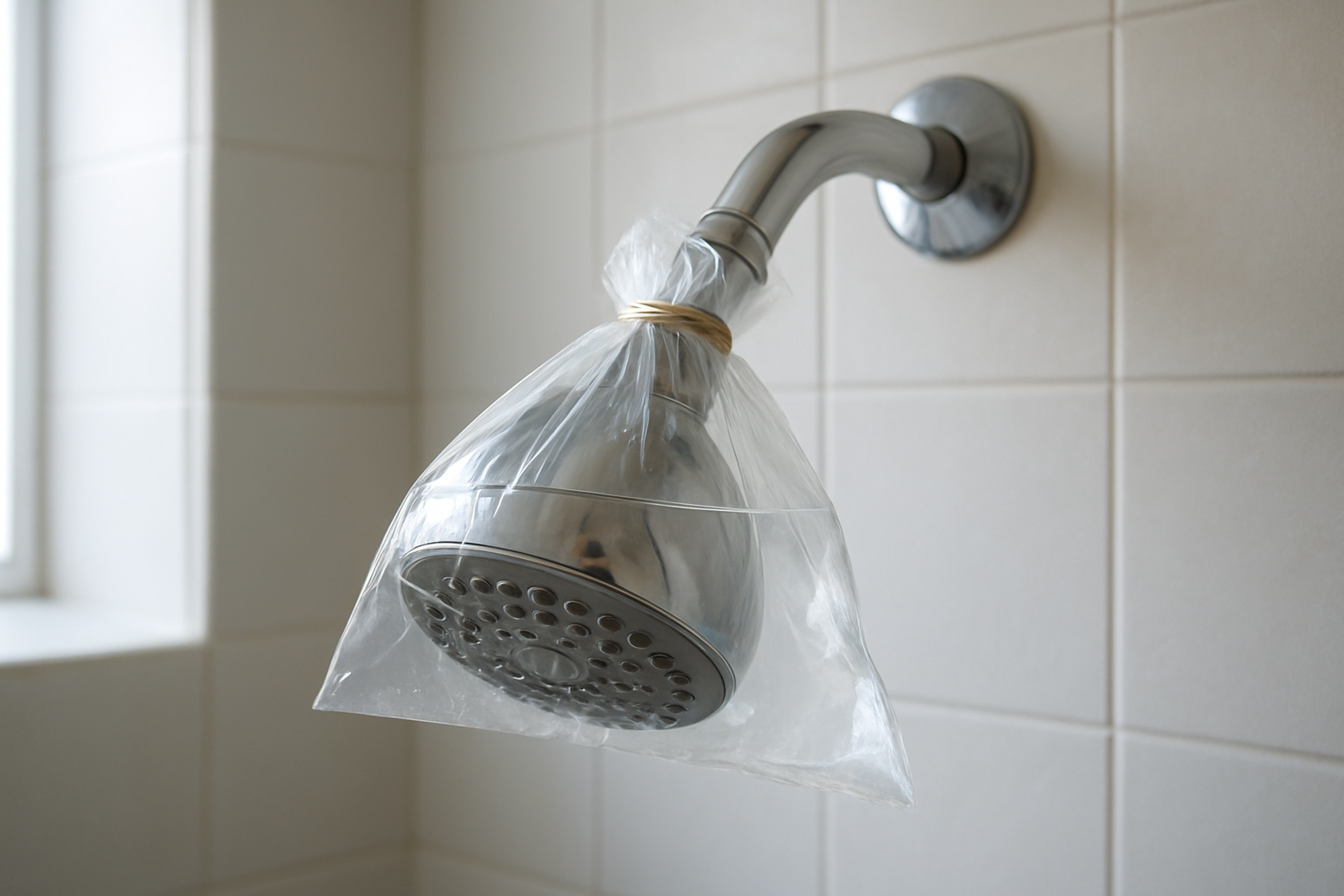
- Fill the bag. Pour enough white vinegar into a plastic bag to fully cover the spray face of the showerhead. For a large showerhead, use a freezer bag because it is stronger.
- Position the bag. Lift the bag over the showerhead so the clogged holes are submerged in vinegar.
- Secure it tightly. Wrap a rubber band or twist tie around the shower arm to hold the bag in place. Make sure the bag is supported and not pulling hard on the plumbing.
- Soak. Let it sit for 30 minutes to 1 hour for routine buildup. For heavy white crust on a standard chrome fixture, you can go longer, but avoid extended soaks on delicate finishes.
- Remove and scrub. Take off the bag and scrub the spray face with an old toothbrush.
- Clear stubborn holes. Gently poke blocked nozzles with a toothpick or wooden skewer. Avoid metal pins if your showerhead has soft rubber nozzles.
- Flush with hot water. Run the shower on hot for 1 to 2 minutes to rinse loosened minerals out of the holes.
- Wipe dry. Buff the showerhead and shower arm with a microfiber cloth.
Method 2: Remove and Soak the Showerhead
If the buildup is heavy, or if the showerhead has weak flow even after the bag method, remove it for a deeper clean.
- Turn the shower off completely. You do not need to shut off water to the whole house for this job, but the shower valve should be firmly off.
- Unscrew the showerhead. Try by hand first. If it is stuck, wrap the connector with a small towel and use an adjustable wrench gently so you do not scratch the finish.
- Soak in a bowl. Place the showerhead in a bowl or bucket with enough white vinegar to cover the spray face. Soak for 30 minutes to 2 hours, depending on buildup and finish.
- Brush and rinse. Scrub the face, rinse well, and run water through the showerhead from both directions if possible.
- Reattach. Screw it back on by hand. If the connection leaks, you may need to replace the old plumber’s tape on the shower arm threads.
After reattaching, turn the shower on and check the spray pattern. You may see small bits of mineral loosen and rinse away at first. Let the water run until the spray looks clear and even.
How Often Should You Clean a Showerhead?
For most homes, cleaning every 2 to 3 months is enough. If you have hard water, clean monthly or whenever you notice the spray pattern changing. A quick wipe-down during regular bathroom cleaning can also help keep mineral spots from hardening.
Here is a simple schedule: wipe the outside weekly, do a vinegar bag soak when spray holes look crusty, and remove the showerhead for a deeper clean once or twice a year if needed.
What Not to Do
- Do not mix vinegar with bleach. This can create dangerous fumes.
- Do not use a metal needle aggressively. It can damage rubber nozzles or scratch the face plate.
- Do not soak delicate finishes overnight. Shorter, repeated cleanings are safer than one very long soak.
- Do not ignore leaks. If water sprays from the connection at the shower arm, the washer or plumber’s tape may need attention.
- Do not assume weak flow is always a clog. If the showerhead is clean but pressure is still poor, there may be a plumbing issue, a clogged valve, or a whole-house water pressure problem.
When Vinegar Isn’t Enough
If the showerhead still sprays poorly after cleaning, remove it and inspect the inlet screen if your model has one. Mineral grit can collect there before water reaches the spray holes. Rinse the screen under running water and brush it gently.
If the fixture is old, cracked, corroded, or repeatedly clogs soon after cleaning, replacement may make more sense. EPA WaterSense-labeled showerheads are independently certified for water efficiency and performance, and EPA estimates that replacing one showerhead with a WaterSense-labeled model can save the average family 2,700 gallons of water per year. ([epa.gov](https://www.epa.gov/watersense/showerheads?utm_source=openai))
Quick Fix for Light Buildup
If the showerhead is not fully clogged but looks spotted, spray a cloth with white vinegar and wrap it around the face for 10 to 15 minutes. Then brush the nozzles, rinse with warm water, and dry. This quick version is handy between deeper cleanings.
The Bottom Line
Learning how to clean a showerhead with vinegar is one of the simplest ways to improve a weak or messy shower spray. Start with a short vinegar bag soak, scrub gently, flush well, and repeat as needed rather than jumping straight to harsh cleaners.
If cleaning restores the spray, add it to your regular bathroom maintenance routine. If it does not, check the inlet screen or consider replacing an old showerhead with a water-efficient model that performs well.