Cordless Pruning Saw Guide: Is It Worth Buying?
If your winter cleanup or summer pruning always turns into a battle with loppers, a cordless pruning saw can be a very welcome upgrade. These compact tools are built for thicker branches that are too much for hand pruners but still small enough to handle without hauling out a full-size chainsaw.
Used well, a cordless pruning saw can save time, reduce strain, and make yard work feel much more manageable. The key is knowing what it’s designed to cut, how to use it safely, and whether the features match the kind of pruning you actually do.
What a cordless pruning saw is best for
A cordless pruning saw sits in the middle ground between pruning shears and a chainsaw. It’s designed for branch work, especially on shrubs, fruit trees, ornamentals, and small limbs that have grown too thick for manual tools.
It’s a smart choice if you regularly deal with:
- Dead or damaged branches
- Storm cleanup after wind or ice
- Thinning tree limbs for better airflow
- Removing overgrown branches near fences or walkways
- Cutting branches from about 1.5 inches up to 4 inches or so, depending on the model
Some models can handle slightly thicker wood, but it’s best to stay within the manufacturer’s recommended cutting range. Forcing the tool through oversized limbs can strain the motor, dull the chain, and make cutting less safe.
Why homeowners like them
The biggest advantage is convenience. A cordless pruning saw is easy to grab, quick to start, and far less tiring than trying to muscle through branches with hand tools.
Here are the main benefits:
- Less effort: The motor does the hard part for you.
- Faster pruning: Branches that take multiple squeezes with loppers can often be cut in seconds.
- Portable: No cord to manage and no gas to mix.
- Good for overhead work: Many models are lightweight enough for short periods of one-handed use, though two hands are usually safer.
- Cleaner cuts: A sharp chain can slice through wood more smoothly than crushed or ragged hand-tool cuts.
For many home gardeners, that combination makes it one of the most useful tools in the shed.
What to look for before you buy
Not all cordless pruning saws are equal. A tool that feels great for one person might be frustrating for another, especially if battery life, weight, or chain tensioning is awkward.
Bar length and cutting capacity
Smaller bars are easier to control and better for tight spaces. A 6-inch bar is a common size for pruning saws and is usually enough for most backyard branch work. Check the actual cutting capacity too, since bar length alone doesn’t tell the whole story.
Weight and balance
Because pruning often involves holding the tool at shoulder height or above, balance matters as much as raw power. A lighter saw is easier to maneuver, but it should still feel stable in your hands rather than top-heavy.
Battery platform
If you already own tools from the same brand, battery compatibility can save money. Many gardeners prefer a tool that uses a battery system shared with a mower, trimmer, blower, or drill.
Chain tensioning
Look for a tool that makes chain adjustment straightforward. Chains naturally loosen with use, and a saw that is difficult to tension will become annoying quickly.
Safety features
Helpful features include a chain brake, hand guard, lock-off switch, and an automatic oiler. These won’t replace safe use, but they do add peace of mind.
How to use it safely
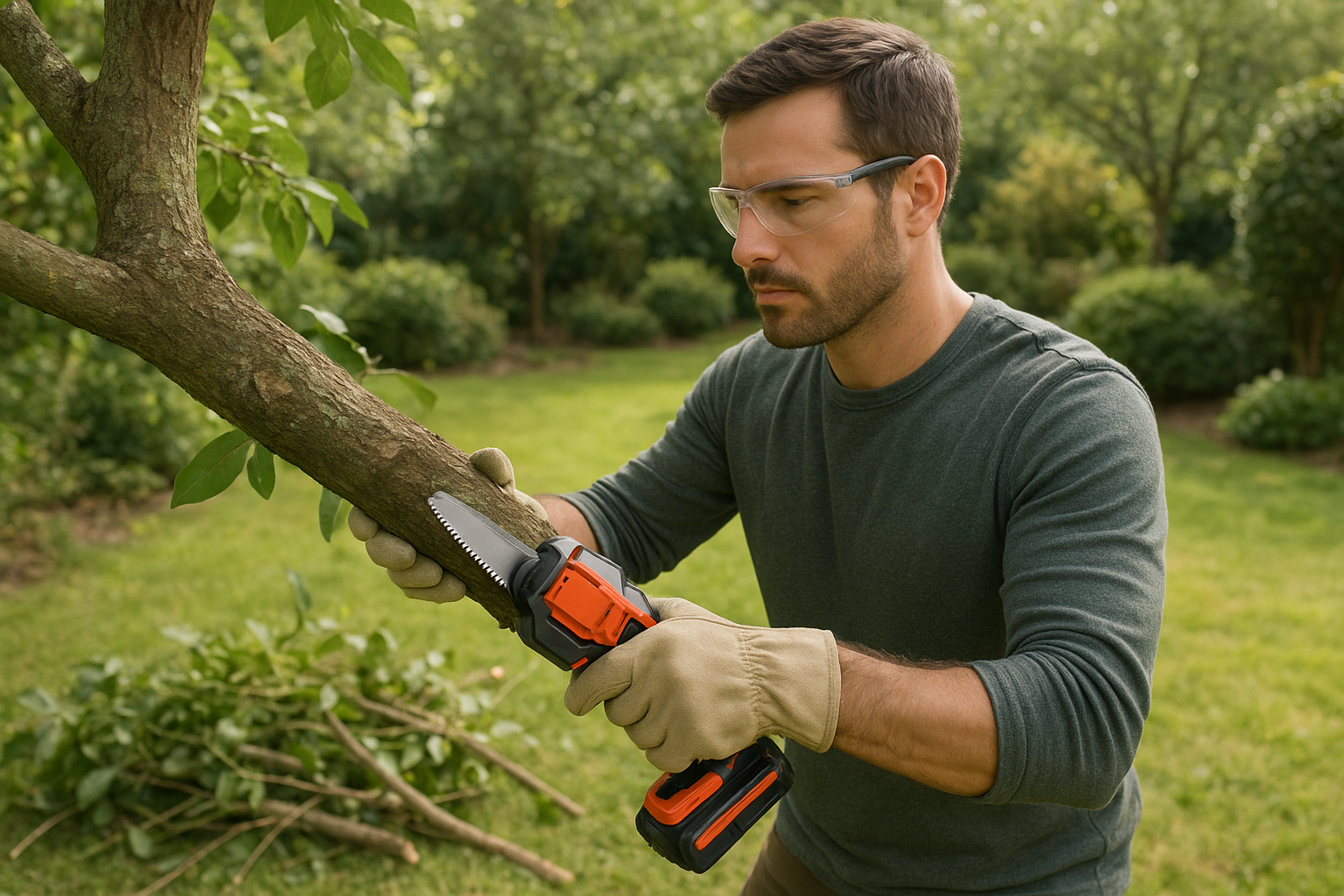
Even though a cordless pruning saw is smaller than a traditional chainsaw, it still deserves respect. The chain can cut fast and can kick back if the saw binds or meets the wood at the wrong angle.
Before you start, put on:
- Safety glasses or a face shield
- Gloves with a good grip
- Sturdy shoes or boots
- Long sleeves and close-fitting clothing
Follow these basic habits every time:
- Inspect the saw before each use.
- Make sure the chain is properly tensioned and lubricated.
- Hold the tool with two hands whenever possible.
- Stand to the side of the cut line, not directly behind the branch.
- Let the chain reach full speed before touching wood.
- Cut in stages for thicker limbs so the branch doesn’t pinch the bar.
If you’re working above shoulder height, slow down. Most pruning accidents happen when people get impatient or overreach. A small step stool or pruning from the ground with a longer reach tool is often the safer choice.
Practical pruning tips for better results
The best tool won’t help much if the cut is poorly placed. Good pruning makes plants healthier and reduces future cleanup.
Cut just outside the branch collar
When removing a limb, avoid cutting flush against the trunk. Leave the branch collar intact so the plant can heal properly.
Use the three-cut method for larger branches
For heavier limbs, make an undercut first, then a top cut farther out to remove the weight, and finish with a clean cut near the collar. This helps prevent bark tearing.
Work in dry conditions when possible
Dry wood is easier to cut and less likely to clog the chain. Wet or sappy branches can slow the tool down and make cleanup messier.
Trim at the right time
For many trees and shrubs, late winter or early spring is a good pruning window, but timing depends on the plant. Flowering shrubs, fruit trees, and ornamental trees each have different needs, so check the species before cutting.
Maintenance that keeps the tool performing well
A cordless pruning saw needs a little care to stay reliable. Fortunately, maintenance is usually simple and quick.
- Clean the bar and chain: Remove sawdust and sap after use.
- Check oil levels: A lubricated chain cuts better and lasts longer.
- Inspect tension: A loose chain is unsafe and can derail.
- Charge batteries properly: Store them in a cool, dry place.
- Sharpen or replace the chain: A dull chain increases strain and gives rough cuts.
It’s also a good idea to store the saw in its case or with a blade cover if one is included. That helps protect both the chain and your hands when you reach for it later.
Who should buy one?
A cordless pruning saw makes the most sense for homeowners who regularly trim trees, clear storm debris, or maintain a yard with mature shrubs and branches. It’s especially useful if you want something more powerful than loppers but lighter and simpler than a gas saw.
It may not be the right tool if you only do occasional light trimming, or if your gardening tasks are mostly deadheading, shaping tender stems, or cutting flowers. In those cases, hand pruners are still the better fit.
The bottom line
A cordless pruning saw is a practical addition to a home garden toolkit when you need speed and cutting power for thicker branches. The best models are light, easy to control, and simple to maintain, making yard work less of a chore.
If your main problem is woody growth that’s too much for manual pruners, this kind of tool can be a real time-saver. Just choose a model with the right battery system, keep it well maintained, and always treat it like the powerful cutting tool it is.