How to Clean a Dishwasher Filter in 10 Minutes
If your glasses come out gritty or your dishwasher has started to smell a little sour, the filter is one of the first places to check. Learning how to clean a dishwasher filter takes about 10 minutes, costs almost nothing, and can make a noticeable difference in how well your machine washes.
Most newer dishwashers have a removable filter near the bottom of the tub, though some older models use a self-cleaning filtration system instead. Always check your owner’s manual for your exact model, but the basic process below works for many common removable filters.
Why the Dishwasher Filter Matters
The dishwasher filter catches food bits, labels, seeds, and greasy residue so they do not recirculate onto your dishes. ENERGY STAR notes that newer dishwasher technology often includes improved water filtration, more efficient jets, and soil sensors that help determine how dirty the wash water is. A clogged filter can interfere with that whole process. ([energystar.gov](https://www.energystar.gov/products/dishwashers?utm_source=openai))
GE Appliances says a decrease in wash performance or dishes that feel gritty can be a sign that the filter needs cleaning. GE recommends inspecting and cleaning fine and ultra-fine filters periodically, about every other month or more often depending on use. ([products.geappliances.com](https://products.geappliances.com/appliance/gea-support-search-content?contentId=35611&utm_source=openai))
How Often Should You Clean a Dishwasher Filter?
A good practical schedule is:
- Every 2 to 4 weeks if you run the dishwasher daily, cook often, or do not rinse off large food scraps.
- Every 1 to 2 months for average household use.
- Right away if dishes feel sandy, the dishwasher smells bad, water is not draining well, or you see food bits after a cycle.
Whirlpool’s product help guidance says cleaning the filter regularly helps keep water flowing strongly and can prevent food particles from recirculating during the cycle. ([producthelp.whirlpool.com](https://producthelp.whirlpool.com/Dishwashers/Dishwasher/Other/Cleaning_and_Odor/Cleaning_and_Maintenance/Cleaning_the_Filter/Cleaning_the_Filter_-_Dishwasher?utm_source=openai))
What You’ll Need
- Warm water
- Mild dish soap
- A soft sponge or dishcloth
- An old soft toothbrush, optional
- A towel
- Rubber gloves, optional but helpful
Avoid steel wool, stiff wire brushes, scouring pads, or knives. GE warns that scouring pads or brushes can damage the filter surface on some models. ([products.geappliances.com](https://products.geappliances.com/appliance/gea-support-search-content?contentId=35611&utm_source=openai))
Step-by-Step: How to Clean a Dishwasher Filter
1. Empty the Dishwasher
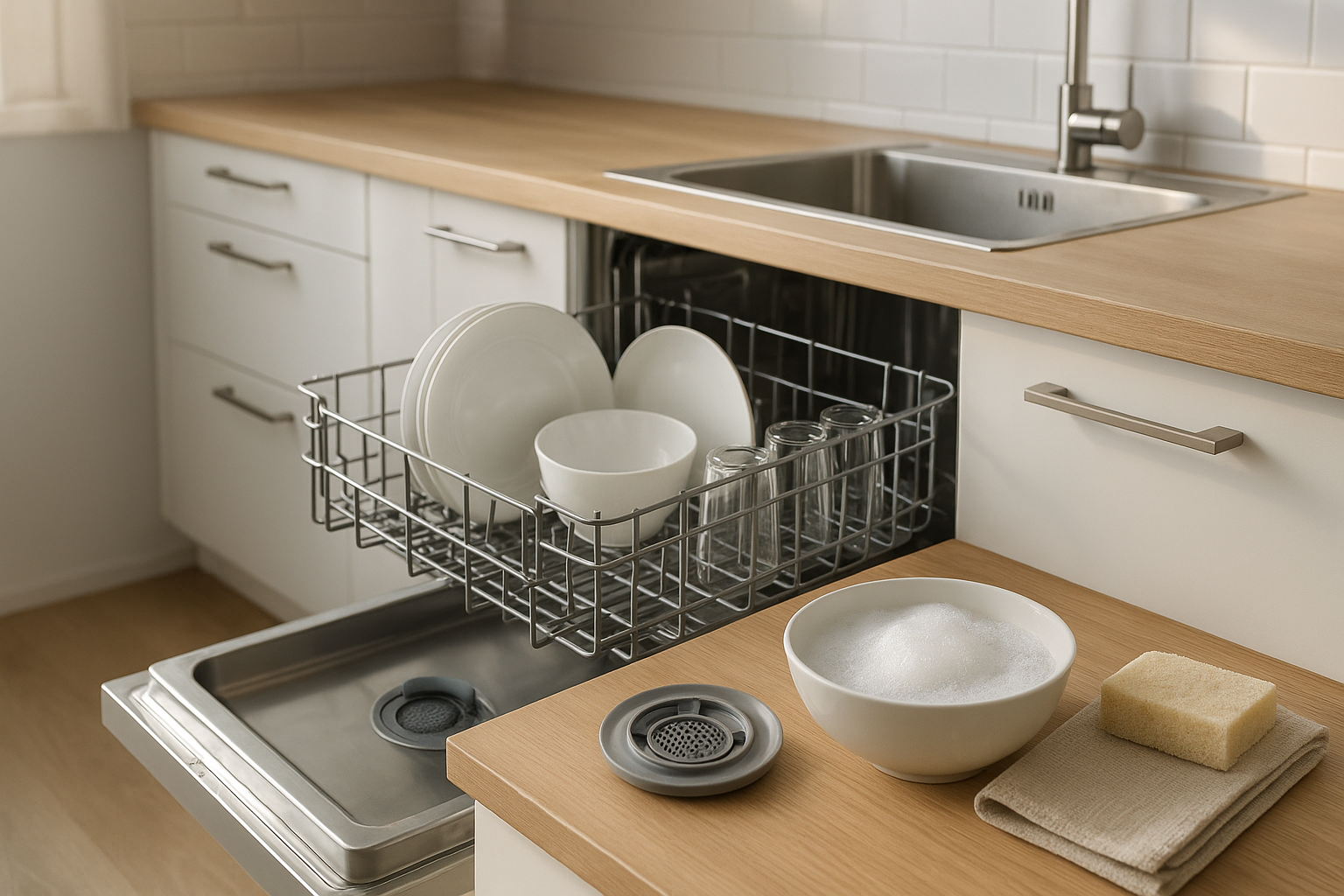
Start with an empty dishwasher. Pull out the bottom rack and set it aside or slide it onto the open door if your kitchen layout allows. This gives you clear access to the bottom of the tub.
2. Find the Filter
Look at the floor of the dishwasher, usually beneath the lower spray arm. Many removable filters are round or cylindrical and sit near the center or back of the tub. Some have arrows, a lock symbol, or a small handle showing which way to twist.
If you cannot find anything that lifts or twists out, do not force parts loose. Older dishwashers and some current models have self-cleaning filtration rather than a removable filter. GE notes that older GE dishwashers, along with some current models, may not have a removable filter to clean. ([products.geappliances.com](https://products.geappliances.com/appliance/gea-support-search-content?contentId=35611&utm_source=openai))
3. Remove the Filter
For many models, you remove the filter by turning it counterclockwise and lifting it out. Some dishwashers have two pieces: a cylindrical upper filter and a flatter mesh or fine filter underneath. Remove each piece gently and pay attention to how it fits so you can put it back the same way.
If the filter feels stuck, stop and check your manual. It may have a locking tab, retaining post, or slightly different removal method.
4. Rinse Away Loose Debris
Carry the filter to the sink and rinse it under warm running water. If there are food scraps, wipe them into the trash rather than sending a lot of solids down the drain. Pay special attention to the mesh, pleats, and any small holes where greasy residue can hide.
5. Wash with Warm Soapy Water
Fill a bowl or the sink with warm water and a few drops of mild dish soap. Let the filter soak for a few minutes if it is greasy. Then wipe it with a soft sponge or cloth. A soft toothbrush can help loosen buildup around the edges, but use a light touch.
Do not use bleach on the filter, and do not run it through a harsh scrub. The goal is to remove buildup without damaging the mesh or plastic frame.
6. Wipe the Filter Well
Before reinstalling the filter, look down into the opening where it sits. You may find a lemon seed, a piece of broken glass, a twist tie, bits of paper label, or a sticky ring of grease. Wearing gloves, remove anything loose and wipe the area with a damp cloth.
If you see a small amount of clean water sitting in the sump area, that can be normal on many dishwashers. If the water is dirty, smelly, or high enough to pool across the bottom, you may have a drainage issue that needs more attention.
7. Reinstall and Lock It in Place
Put the filter back exactly as it came out. Most round filters need to be twisted clockwise until they lock. This matters: a loose or crooked filter can allow food particles to move around the dishwasher or interfere with the spray arm.
Spin the lower spray arm by hand before replacing the rack. It should move freely without hitting the filter, a utensil basket, or anything else.
Should You Run a Cleaning Cycle Too?
Cleaning the filter removes trapped debris, but it does not always remove mineral deposits, grease film, or odor from the rest of the dishwasher. GE recommends focusing on the filter as part of a deeper dishwasher cleaning routine and notes that hard water can leave deposits inside the machine. ([geappliances.com](https://www.geappliances.com/ge/lifestyles/how-to-deep-clean-your-dishwasher.htm?utm_source=openai))
After the filter is clean, you can run an empty hot cycle with a dishwasher cleaner made for your machine. Some manufacturers also provide instructions for vinegar or citric acid, but check your manual first, especially if your dishwasher has stainless steel, rubber, or specialty interior parts.
Common Mistakes to Avoid
- Forgetting to lock the filter: If it is not seated properly, dishes may come out dirty or the spray arm may not move correctly.
- Using harsh tools: Metal scrubbers and stiff brushes can tear fine mesh or scratch plastic.
- Cleaning only with a dishwasher tablet: A cleaner can freshen the tub, but it may not remove chunks of food trapped in the filter.
- Ignoring broken glass: If glass has broken in the dishwasher, wear thick gloves and use caution around the filter well.
- Assuming every dishwasher has the same filter: Filter designs vary by brand, age, and model.
How to Keep the Filter Cleaner Longer
- Scrape plates well before loading, especially rice, pasta, eggs, seeds, and leafy bits.
- Peel off jar labels before washing jars in the dishwasher.
- Do not overload the bottom rack, which can block spray and leave more residue behind.
- Use the right amount of detergent for your water hardness and soil level.
- Run hot water at the sink for a few seconds before starting the dishwasher if your manual recommends it.
When Cleaning the Filter Isn’t Enough
If the filter is clean but dishes still come out gritty, check the spray arm holes for clogs, make sure the detergent dispenser opens fully, and confirm that the water is getting hot. If water remains in the bottom after a cycle, or the machine smells like sewage, the issue may be a clogged drain hose, garbage disposal knockout plug, air gap, or installation problem rather than the filter itself.
For most homes, though, a clean filter is one of the easiest wins in kitchen maintenance. Put it on your calendar every month or two, and your dishwasher will have a much better chance of doing what it is supposed to do: send dishes back to the cabinet clean, not gritty.