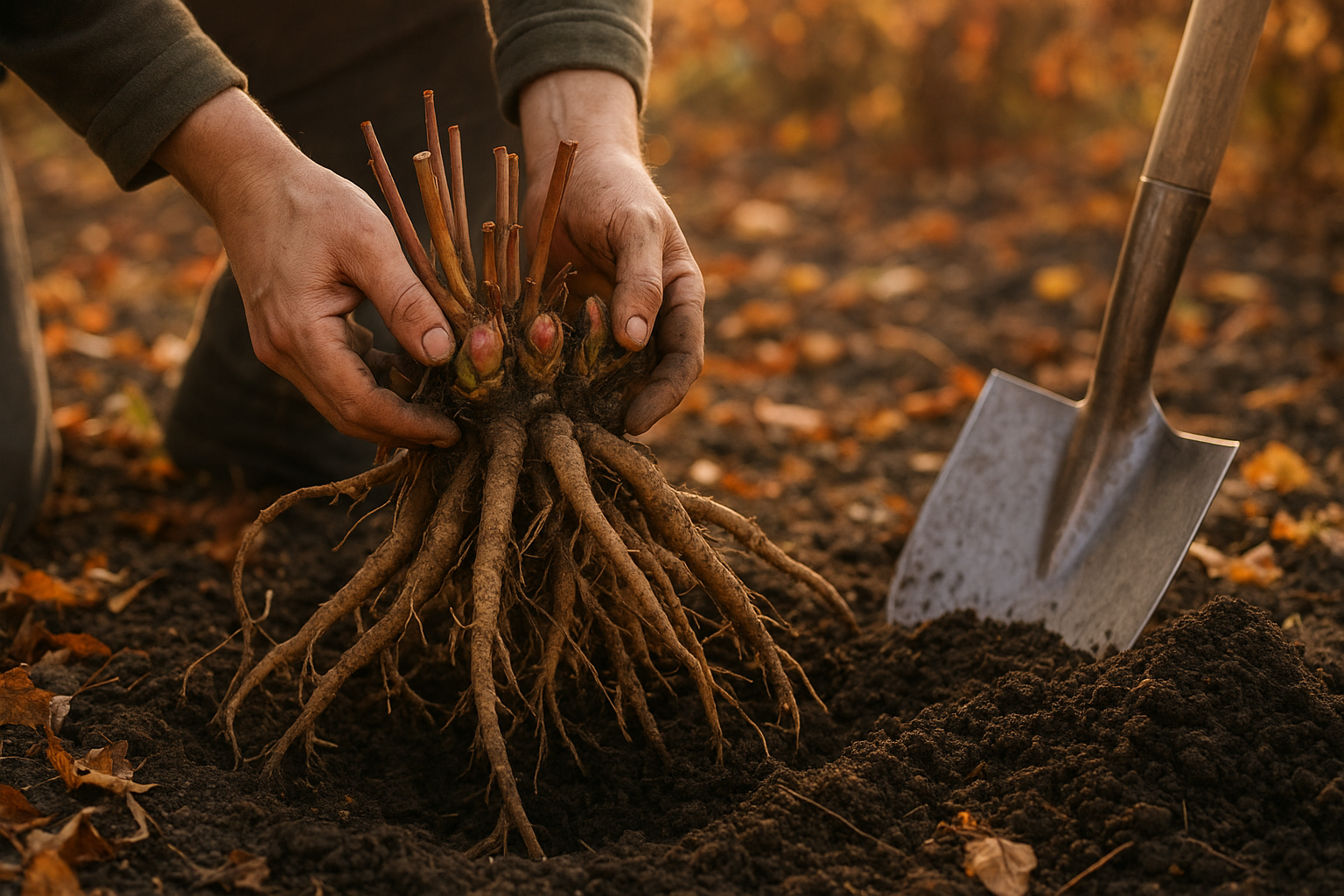
How to Divide Peonies in Fall Without Losing Blooms
If your peony has become a huge, crowded clump or you want to share a favorite plant, fall is the right season to do the job. The key is to dig carefully, make divisions with enough buds, and replant shallowly so the plant can settle in before winter.
Peonies do not need dividing every few years like some perennials. In fact, they often bloom best when left alone. But when division is needed, doing it correctly can give you strong new plants without setting them back for years.
When to Divide Peonies in Fall
The best time to divide peonies is early fall, after the worst heat has passed and the plant is starting to slow down. Iowa State University Extension notes that September is the best time to transplant or divide peonies in Iowa, while other extension guidance commonly points to early fall or after the foliage has begun dying back. ([yardandgarden.extension.iastate.edu](https://yardandgarden.extension.iastate.edu/how-to/transplanting-and-dividing-peonies?utm_source=openai))
For many U.S. gardeners, that means somewhere from late August through October, depending on climate. In colder regions, aim earlier so the divisions have time to grow new roots before the ground freezes. In warmer zones, wait until temperatures ease and the plant is closer to dormancy.
Should You Divide Your Peony?
Before you grab the spade, make sure the plant actually needs it. Peonies resent unnecessary disturbance and can take a season or two to return to full bloom after being moved. Colorado State University Extension advice shared through Ask Extension notes that peonies seldom require division and are best divided only when necessary, such as when bloom performance has declined. ([ask.extension.org](https://ask.extension.org/kb/faq.php?id=247613&utm_source=openai))
Good reasons to divide include:
- The clump is very large and crowded. Stems may be packed tightly together, with fewer flowers than in past years.
- You need to move the plant. Maybe a tree has grown and created too much shade, or a bed is being redesigned.
- You want more plants. A healthy old peony can often be split into several new divisions.
- The plant has stopped blooming well. Division may help if crowding is the issue, though shade, planting depth, or excess nitrogen may also be to blame.
If your peony is blooming beautifully, leave it alone. A happy peony can stay in the same spot for many years.
Tools and Supplies
Gather everything before you dig so the roots spend less time drying out.
- Sharp spade or garden fork
- Pruners
- Sharp garden knife, pruning saw, or hori hori knife
- Bucket of water or hose for rinsing soil from roots
- Compost, if your soil needs improvement
- Measuring stick or trowel for checking planting depth
- Mulch for after the ground cools
Clean your cutting tools before making divisions, especially if you have had disease issues in the garden. A sharp blade makes cleaner cuts and causes less damage to the crown.
How to Divide Peonies in Fall
1. Cut the Stems Back
Start by cutting the stems close to the ground. This makes the clump easier to handle and helps you see what you are doing. If the foliage had leaf spots, mildew, or other disease symptoms during the season, bag it and throw it away instead of composting it.
2. Dig Wide Around the Clump
Peony roots are thick, fleshy, and easy to slice by accident. Push your spade into the soil 8 to 12 inches away from the outer stems and work all the way around the plant. Then gently lift from several sides rather than prying hard from one spot.
Expect the clump to be heavy. For an old peony, it may take patience and a second set of hands to lift it without snapping off too many roots.
3. Rinse Off the Soil
Once the clump is out, rinse away enough soil to see the crown and the buds, often called eyes. These eyes are the small pink, red, or white growing points that will produce next year’s stems.
This step matters because blind cutting can leave some divisions with no eyes. A chunk of root without eyes may not grow into a proper plant.
4. Cut Into Divisions With 3 to 5 Eyes
Use a sharp knife or pruning saw to cut the crown into pieces. Each division should have several healthy eyes and a good portion of fleshy root. Kansas State University Extension recommends three to five strong bud eyes per division, and Iowa State guidance also notes that divisions with fewer than three eyes can take longer to bloom. ([hnr.k-state.edu](https://hnr.k-state.edu/extension/horticulture-resource-center/publications/publications/turf-ornamentals/flower-publications/Peonies.pdf?utm_source=openai))
It is tempting to make as many small pieces as possible, but tiny divisions are slower. A division with 3 to 5 eyes is a good balance: large enough to recover well, but small enough to establish as its own plant.
As you cut, remove any soft, rotten, hollow, or badly damaged root sections. Firm white or tan roots are worth keeping. Mushy tissue should go.
Where to Replant Peony Divisions
Choose the new spot before you divide, if possible. Peonies perform best in full sun and well-drained soil. They can tolerate some light shade, but too much shade is a common reason for weak flowering.
Give each division room to grow. Space herbaceous peonies about 3 feet apart so air can move between plants. Good spacing also makes future cleanup easier and can reduce disease pressure on the foliage.
Work compost into the planting area if your soil is poor, but avoid making an overly rich pocket of fertilizer. Too much nitrogen can encourage leafy growth at the expense of flowers.
The Planting Depth Is the Big Secret
If there is one place gardeners go wrong with peonies, it is planting too deep. The eyes should sit close to the soil surface. Kansas State University Extension warns that peony flower failure can happen when the bud eye is planted too deeply or becomes buried by organic matter over time. ([hnr.k-state.edu](https://hnr.k-state.edu/extension/horticulture-resource-center/publications/publications/turf-ornamentals/flower-publications/Peonies.pdf?utm_source=openai))
In cold-winter areas, set the eyes about 1 to 2 inches below the soil surface. In milder regions, keep them closer to 1 inch deep. Use a stick or trowel laid across the hole as a guide, then measure down to the eyes before backfilling.
Set the division so the eyes point upward. Spread the roots gently, backfill with soil, and firm it with your hands to remove large air pockets. Do not stomp on the planting hole; peony roots are fleshy and can be damaged by heavy pressure.
Watering and Mulching After Division
Water each new division deeply after planting. The goal is to settle soil around the roots, not to keep the bed soggy. Continue watering during dry fall weather until the ground freezes or regular rains take over.
After the soil cools, add a light mulch layer around the plant to reduce freeze-thaw heaving. Keep mulch from piling directly over the crown. In very cold climates, a temporary winter mulch can help new divisions, but pull excess mulch back in spring so the eyes are not buried too deeply.
Will Divided Peonies Bloom Next Year?
Maybe, but do not count on a full show right away. Newly divided peonies often need time to settle. Some may bloom lightly the first spring, while others skip a year as they rebuild roots. Smaller divisions can take longer, sometimes several years, to bloom well.
If your division has healthy eyes, was planted in sun, and was not buried too deeply, patience is usually the answer. Avoid digging it up again the next spring just because it looks small.
Common Mistakes to Avoid
- Dividing in spring. Spring division can interrupt the season’s growth and reduce flowering. Fall is gentler on the plant.
- Making divisions too small. One-eye pieces may survive, but they are slow to become impressive plants.
- Planting too deep. This is one of the most common reasons peonies grow leaves but no flowers.
- Choosing a shady site. Peonies need strong light for reliable bloom.
- Overfeeding with nitrogen. Rich lawn fertilizer near peonies can lead to lush leaves and fewer flowers.
- Leaving diseased foliage in the bed. Fall cleanup helps reduce problems next year.
A Simple Fall Peony Division Checklist
- Wait until early fall, ideally as the plant begins dormancy.
- Cut stems down near ground level.
- Dig widely and lift the whole clump carefully.
- Rinse soil away so you can see the eyes.
- Cut divisions with 3 to 5 eyes and healthy roots.
- Replant in full sun with eyes only 1 to 2 inches deep.
- Water well and mulch lightly after the soil cools.
Dividing peonies looks intimidating the first time, mostly because the roots are so large and strange-looking. Once you can identify the eyes, the process becomes straightforward. Work slowly, plant shallowly, and your fall divisions should grow into sturdy peonies that reward you for years.