How to Clean a Showerhead for Stronger Water Pressure
If your shower has started spraying sideways, dribbling from half the holes, or feeling weaker than it used to, the showerhead may simply be clogged with mineral buildup. The good news: learning how to clean a showerhead is a quick home task that usually takes more waiting than scrubbing.
Hard water minerals collect around the spray nozzles over time, especially if the shower is used daily. Regular cleaning also removes dirt and debris; the CDC recommends cleaning showerheads and faucet aerators whenever you can see buildup on them. ([cdc.gov](https://www.cdc.gov/drinking-water/prevention/preventing-waterborne-germs-at-home.html?utm_source=openai))
Why Showerheads Get Clogged
Most clogs come from scale, which is the chalky mineral residue left behind as water dries. You may notice white crust around the holes, uneven spray, or a showerhead that whistles, sputters, or shoots water in odd directions.
Cleaning can help restore the spray pattern, but it is also a useful moment to check how much water the fixture uses. Standard showerheads use up to 2.5 gallons per minute, while WaterSense-labeled models are certified to use no more than 2.0 gallons per minute and still meet performance criteria. ([epa.gov](https://www.epa.gov/watersense/showerheads?utm_source=openai))
What You’ll Need
- White vinegar
- A quart-size plastic bag or small bowl
- Rubber band, twist tie, or zip tie
- Old toothbrush or soft cleaning brush
- Microfiber cloth
- Toothpick or wooden skewer, optional
- Adjustable wrench, optional
- Plumber’s tape, optional if you remove the showerhead
A quick caution: vinegar is helpful for mineral deposits, but it is acidic. Do not use long vinegar soaks on natural stone, unsealed grout, or delicate specialty finishes unless the manufacturer says it is safe. If your showerhead has an oil-rubbed bronze, matte black, brass, or nickel finish, check the care instructions first and choose the shortest effective soak.
Step 1: Try the No-Removal Vinegar Bag Method
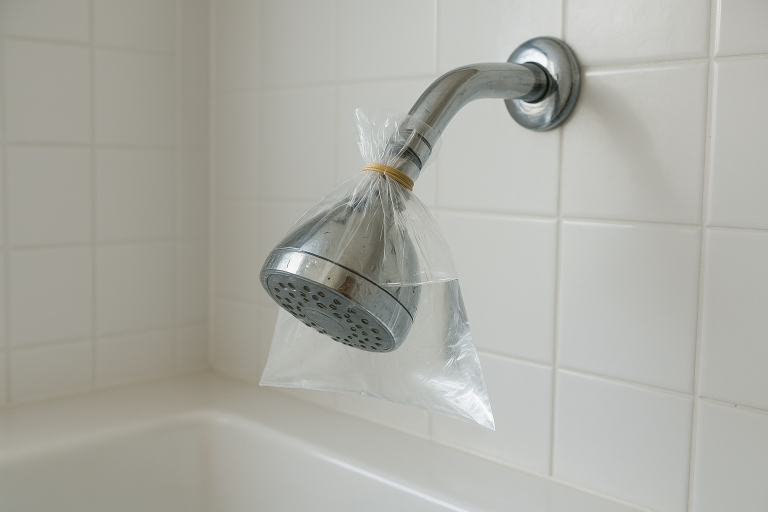
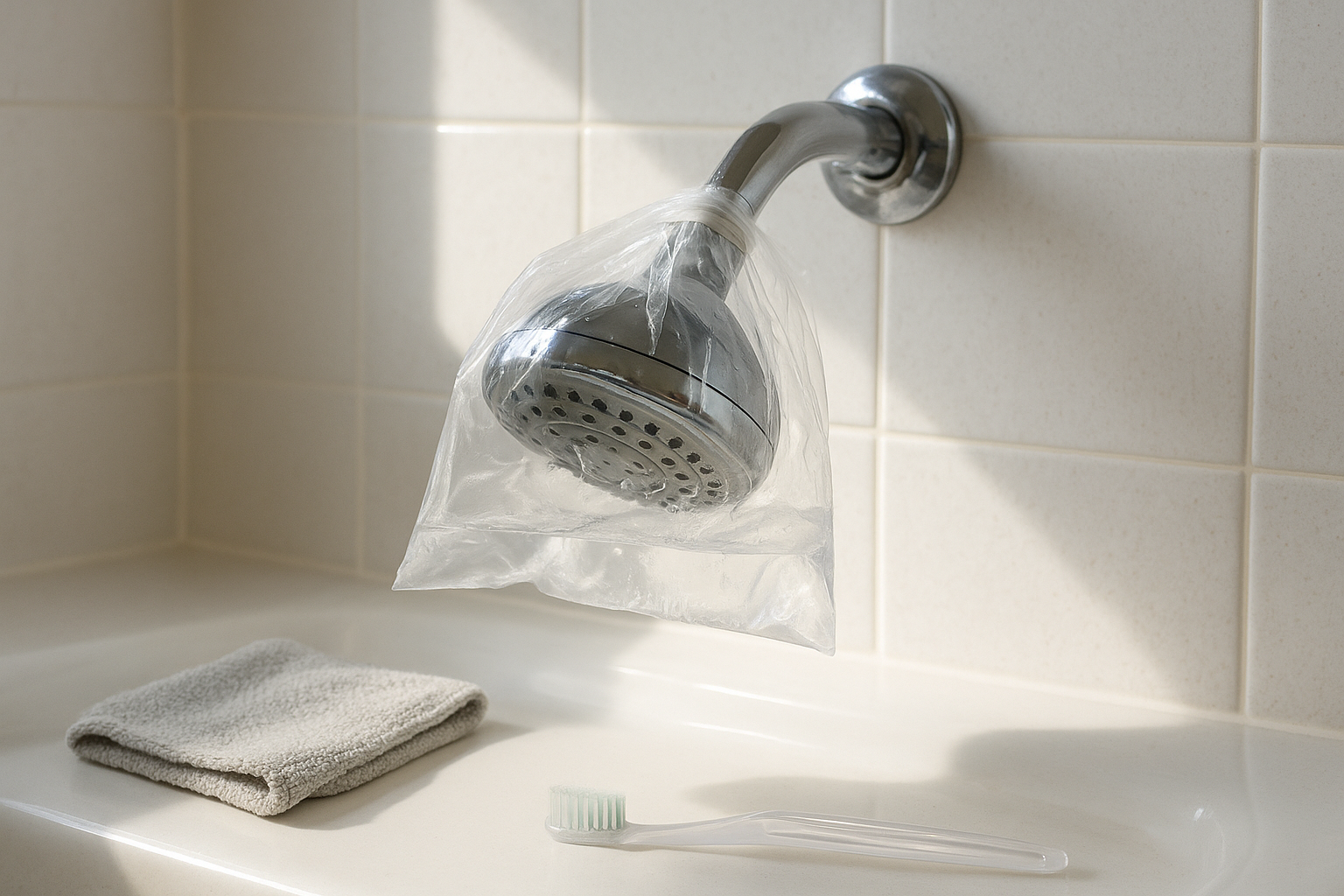
This is the easiest way to clean a fixed showerhead. Fill a plastic bag with enough white vinegar to cover the face of the showerhead. Slip the bag over the showerhead so the clogged nozzles are submerged, then secure it tightly with a rubber band or twist tie.
Let it soak for 30 minutes to 1 hour for light buildup. For heavier mineral crust, you can go longer on a plain chrome or stainless fixture, but avoid overnight soaking on unknown or delicate finishes. University of Michigan Health’s showerhead-cleaning guidance notes that soaking in white vinegar can help dissolve hard-water mineral deposits, with 10 to 20 minutes often enough for removable parts. ([med.umich.edu](https://www.med.umich.edu/1libr/PedDialysis/CleaningShowerHeads.pdf?utm_source=openai))
Step 2: Scrub the Nozzles Gently
Remove the bag and pour the used vinegar down the drain with plenty of water. Use an old toothbrush to scrub the showerhead face, focusing on the rubber nozzles and any white crust around the holes.
If a few openings are still blocked, gently work them loose with a toothpick or wooden skewer. Avoid metal pins or knives, which can scratch the finish or damage rubber spray tips. Wipe everything clean with a damp microfiber cloth.
Step 3: Flush the Showerhead
Turn on hot water and let the shower run for 1 to 2 minutes. This flushes loosened minerals out of the showerhead. Stand back at first, because the spray may sputter or spit small bits of scale.
Check the pattern. If most of the holes are spraying evenly again, you are done. If the showerhead still dribbles from one side or has obvious internal buildup, remove it for a deeper clean.
How to Deep Clean a Removable Showerhead
If the bag method did not solve the problem, unscrew the showerhead by hand. If it is stuck, wrap the nut with a cloth to protect the finish, then use an adjustable wrench with light pressure. Do not force it; old fittings can crack if twisted too aggressively.
- Remove the showerhead. Turn it counterclockwise from the shower arm.
- Check for a washer or screen. Many showerheads have a small rubber washer or mesh screen inside the connection. Set these aside carefully.
- Soak the face. Place the showerhead in a bowl of white vinegar for 20 minutes, then check the buildup. Continue in short intervals if needed.
- Brush and rinse. Scrub the face and rinse through the connection end to push loosened debris out.
- Reinstall. Replace the washer or screen. If the threaded connection leaks after reinstalling, remove the showerhead and wrap the shower arm threads with fresh plumber’s tape before tightening again.
What If Vinegar Is Not Enough?
For stubborn scale, a commercial limescale remover may work faster than vinegar. Choose one labeled safe for your showerhead finish, follow the product directions, ventilate the bathroom, and never mix cleaners. In particular, do not mix vinegar with bleach or bleach-based bathroom sprays.
If the showerhead is old, corroded, cracked, or still weak after cleaning, replacement may be the better fix. A modern WaterSense-labeled showerhead can reduce water use compared with a standard 2.5-gpm model, and the EPA estimates that replacing showerheads with WaterSense-labeled models can save the average family about 2,700 gallons of water per year. ([epa.gov](https://www.epa.gov/sites/default/files/2017-01/documents/ws-products-factsheet-showerheads.pdf?utm_source=openai))
How Often Should You Clean a Showerhead?
For most homes, clean the showerhead every 2 to 3 months. If you have hard water, visible white crust, or a shower that gets heavy use, monthly cleaning may be more realistic. The simplest schedule is to soak the showerhead when you already clean the tub or shower walls.
You should also clean it after a long period without use. The CDC advises flushing faucets and showerheads that have not been used for a while, and after a water pressure drop, as part of reducing water-related illness risks at home. ([cdc.gov](https://cdc.gov/drinking-water/prevention/index.html?utm_source=openai))
Small Habits That Prevent Buildup
- Wipe the showerhead face weekly. A quick rub with a damp cloth keeps minerals from hardening around the nozzles.
- Run the fan during and after showers. Less lingering moisture means less grime on nearby surfaces.
- Fix drips promptly. A slow leak leaves constant mineral deposits right where water exits.
- Use the rubber nozzles. If your showerhead has flexible silicone tips, rub them with your thumb during cleaning to break loose scale.
- Consider a replacement if cleaning is constant. If scale returns within days, the fixture may be worn or poorly suited to your water.
When to Call a Plumber
If only the shower has weak pressure, cleaning or replacing the showerhead often solves it. But if every faucet in the bathroom has low pressure, the issue may be elsewhere: a partially closed valve, clogged supply line, pressure regulator problem, or plumbing corrosion.
Call a plumber if the shower arm leaks inside the wall, the showerhead connection is frozen in place, water pressure suddenly drops throughout the house, or rusty water appears. Those are not cleaning problems, and forcing the fixture can create a bigger repair.
The Bottom Line
The best way to clean a showerhead is to dissolve mineral buildup with a short vinegar soak, scrub gently, and flush it well. It is a small job, but it can make your shower feel noticeably better—and it is much cheaper than replacing a perfectly good fixture.