How to Clean a Dishwasher Filter and Spray Arms
If your dishwasher has started leaving grit on glasses, smelling a little sour, or turning out plates that look only half-washed, do not rush to replace it. In many cases, the fix is as simple as cleaning the filter and checking the spray arms.
Modern dishwashers often rely on a removable filter to catch food bits, and those bits can build up faster than you think. The spray arms can also clog with seeds, paper labels, mineral scale, or tiny food particles, which weakens the water spray that actually cleans your dishes.
Why This Job Matters
A dirty dishwasher filter can trap grease and food debris, then send cloudy water and fine particles back over your dishes. Consumer Reports notes that many manufacturers suggest cleaning dishwasher filters every two to three months, though busy households may need to do it more often. ([consumerreports.org](https://www.consumerreports.org/appliances/dishwashers/how-to-clean-your-dishwasher-filter-a7398510973/?utm_source=openai))
Spray arms matter just as much. Bosch recommends cleaning dishwasher spray arms every few months, and Thermador notes that limescale can block spray arm nozzles and reduce cleaning performance. ([bosch-home.com](https://www.bosch-home.com/us/owner-support/dishwashers/cleaning-maintenance?utm_source=openai))
The good news: this is a low-cost, no-special-skill maintenance task. Most of the time, you need warm water, dish soap, a soft brush, and about 15 to 25 minutes.
How Often to Clean a Dishwasher Filter
Use your owner’s manual as the final word for your model, but this schedule works well for most households:
- Light use, well-scraped dishes: every 2 to 3 months.
- Daily use: about once a month.
- Large family, lots of cooking, or frequent baked-on food: every 2 to 4 weeks.
- After a holiday, party, or heavy cooking stretch: check it even if it is not due yet.
Some manufacturers give a range based on use. Thermador, for example, says to clean the filter every one to four months depending on usage and after loads with a lot of food soil or starch. ([thermador.com](https://www.thermador.com/us/support/customer-care/dishwashers/how-to-clean-your-dishwasher?utm_source=openai))
Signs Your Dishwasher Filter Needs Cleaning
You do not have to wait for a calendar reminder. Clean the filter if you notice:
- Grit or small food specks on glasses and bowls
- A sour, musty, or greasy smell inside the dishwasher
- Standing water or slow draining after a cycle
- Dishes that feel slick or look cloudy
- Bits of spinach, rice, eggshell, or pasta stuck around the bottom of the tub
- A cycle that sounds normal but cleans poorly
If your dishwasher suddenly stops cleaning well, also check that the spray arms spin freely before you run the next load. Whirlpool’s quick-start guidance reminds users to make sure spray arms are not blocked by items in the racks. ([whirlpool.com](https://www.whirlpool.com/content/dam/global/documents/202406/quick-start-guide-w11680103-revB.pdf?utm_source=openai))
What You’ll Need
- Rubber gloves, optional but helpful
- Warm water
- Mild dish soap
- Soft sponge or dishcloth
- Old toothbrush or small soft brush
- Toothpick, wooden skewer, or soft pipe cleaner for spray arm holes
- Small bowl or sink for soaking parts
- White vinegar, optional for mineral buildup
Avoid steel wool, harsh scouring pads, and forcing parts loose. Dishwasher filters and spray arms are often plastic, and small clips or tabs can snap if handled roughly.
How to Clean a Dishwasher Filter
1. Empty the dishwasher
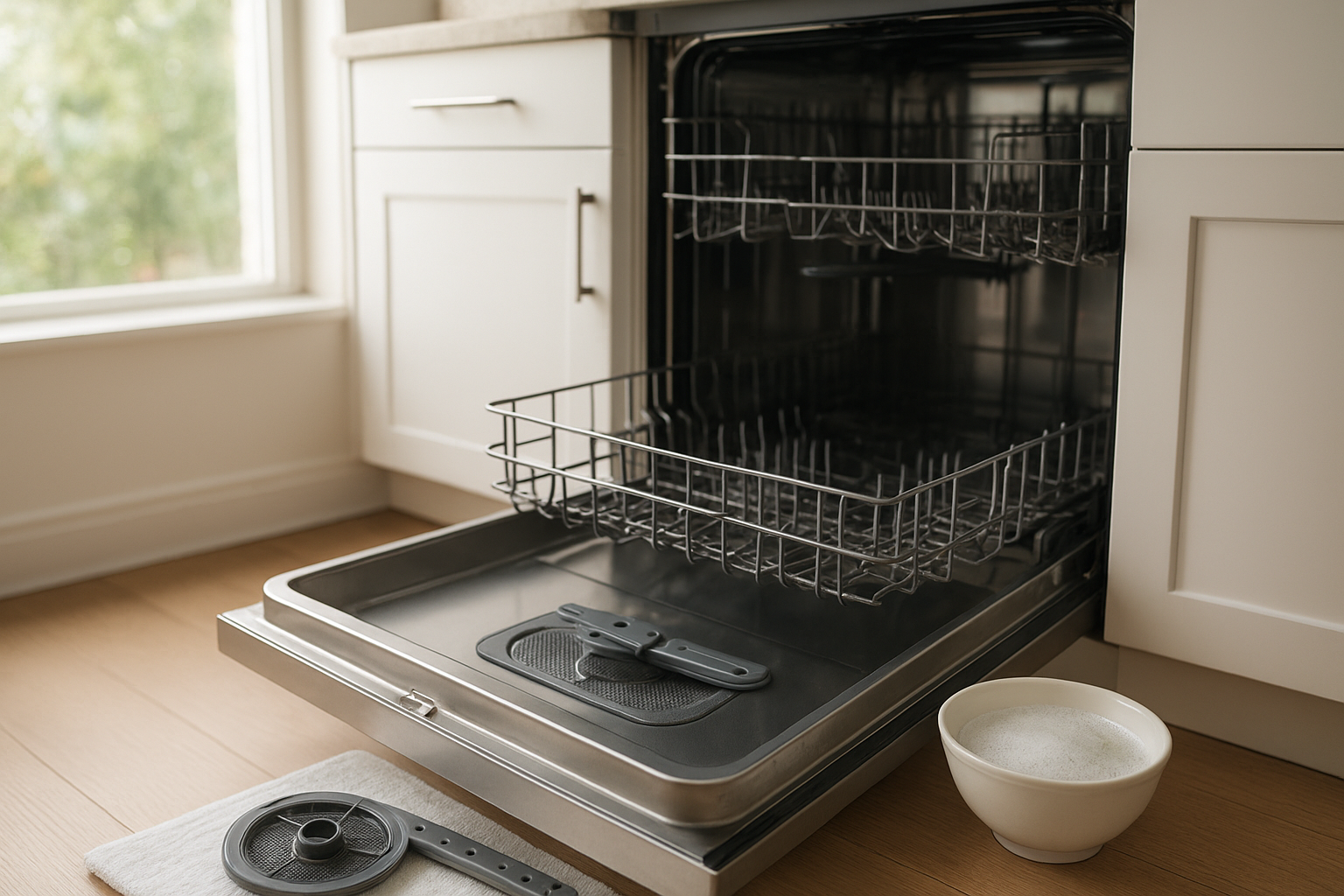
Pull out the bottom rack so you can reach the floor of the dishwasher. If there is standing water, scoop out what you can with a cup and blot the rest with a towel.
2. Find the filter
Most removable filters sit at the bottom center of the dishwasher, under or near the lower spray arm. Look for a round or cylindrical piece with arrows, a handle, or a twist-lock top. If you are unsure, search your appliance model number and the words “filter cleaning” before pulling anything apart.
3. Remove the filter gently
Many filters unlock with a quarter-turn counterclockwise, then lift out. Some have an upper cylindrical filter and a flat lower screen. Set the pieces on a towel in the order you removed them so reassembly is easier.
4. Scrape off loose debris
Knock loose food into the trash, not the sink if you can help it. Rice, noodles, seeds, eggshells, and vegetable skins are common culprits.
5. Wash with warm, soapy water
Rinse the filter under warm running water. Use a soft brush or old toothbrush to clean the mesh and grooves. Consumer Reports suggests warm soapy water and a sponge, scrub brush, bottle brush, or toothbrush for hard-to-reach areas. ([consumerreports.org](https://www.consumerreports.org/appliances/dishwashers/how-to-clean-your-dishwasher-filter-a7398510973/?utm_source=openai))
6. Wipe the filter well
Before putting the filter back, wipe the sump area where it sits. Remove any labels, glass shards, bones, twist ties, or food pieces. Be careful with your fingers; broken glass can hide in the bottom.
7. Reinstall securely
Put every filter piece back exactly as it came out. This matters. A loose or crooked filter can let debris recirculate into the dishwasher and clog the spray arms.
How to Clean Dishwasher Spray Arms
If your filter was dirty, the spray arms are worth checking too. They are the long rotating arms with small holes that spray water during the wash cycle.
1. Spin them by hand
Before removing anything, spin each spray arm. It should move freely without hitting a plate, rack, utensil, or tall pan. A blocked spray arm can make one whole section of the dishwasher come out dirty.
2. Look for clogged holes
Check the tiny spray holes for food bits, paper, mineral crust, or seeds. If the arm is removable, follow your manual’s instructions. Some lift off, some unscrew, and some have clips.
3. Rinse under warm water
Run water through the spray arm to flush out loose debris. Shake it gently. If you hear grit rattling inside, keep rinsing until it clears.
4. Clear holes carefully
Use a toothpick, wooden skewer, or soft brush to loosen debris from each hole. Do not enlarge the holes or scrape aggressively; the spray pattern depends on their size and shape.
5. Soak for mineral buildup
If you have hard water and see chalky white deposits, soak the spray arm in warm vinegar water for 15 to 30 minutes, then rinse well. Do not use vinegar on natural stone counters, and do not mix vinegar with bleach or harsh cleaners.
6. Reattach and test
Reinstall the spray arms and spin them again by hand. They should rotate smoothly and sit level.
Should You Run a Cleaning Cycle Afterward?
Yes, it is a good finishing step if the dishwasher smells bad or had a very dirty filter. After the filter and spray arms are clean and reinstalled, run an empty hot cycle with a dishwasher cleaner made for your machine, or follow your manufacturer’s cleaning-cycle instructions.
Do not run a cleaning cycle before removing heavy debris. Otherwise, you may simply push old food and grease around the machine.
Mistakes to Avoid
- Do not use bleach casually. It can damage stainless steel interiors and should never be mixed with vinegar or other cleaners.
- Do not pry parts loose. If a spray arm or filter will not budge, check the manual first.
- Do not reinstall a wet, greasy filter without scrubbing it. Rinsing alone may not remove the film that holds odors.
- Do not ignore loading issues. Tall cutting boards, pans, and utensils can block spray arms even when everything is clean.
- Do not pre-wash everything spotless. Scrape off chunks, but let the detergent and dishwasher do their job. ENERGY STAR notes that today’s dishwashers and detergents are designed to handle food residue without heavy pre-rinsing. ([energystar.gov](https://www.energystar.gov/products/dishwashers?utm_source=openai))
When Cleaning Is Not Enough
If you cleaned the filter, cleared the spray arms, and loaded the dishwasher correctly but dishes are still dirty, check a few other common issues: low rinse aid, old detergent, hard water buildup, a blocked drain hose, or water that is not getting hot enough.
Call an appliance technician if the dishwasher will not drain, leaks, makes grinding noises, trips a breaker, or has a burning smell. But for everyday grit, odor, and weak cleaning, the filter and spray arms are the best place to start.
The Simple Maintenance Habit
Once a month, pull the bottom rack, check the filter, spin the spray arms, and wipe the door gasket. It takes just a few minutes, and it can save you from rewashing dishes, buying extra detergent, or assuming the dishwasher is worn out before its time.
A clean dishwasher filter keeps water moving. Clean spray arms send that water where it needs to go. Together, they make a dishwasher work the way it should.